

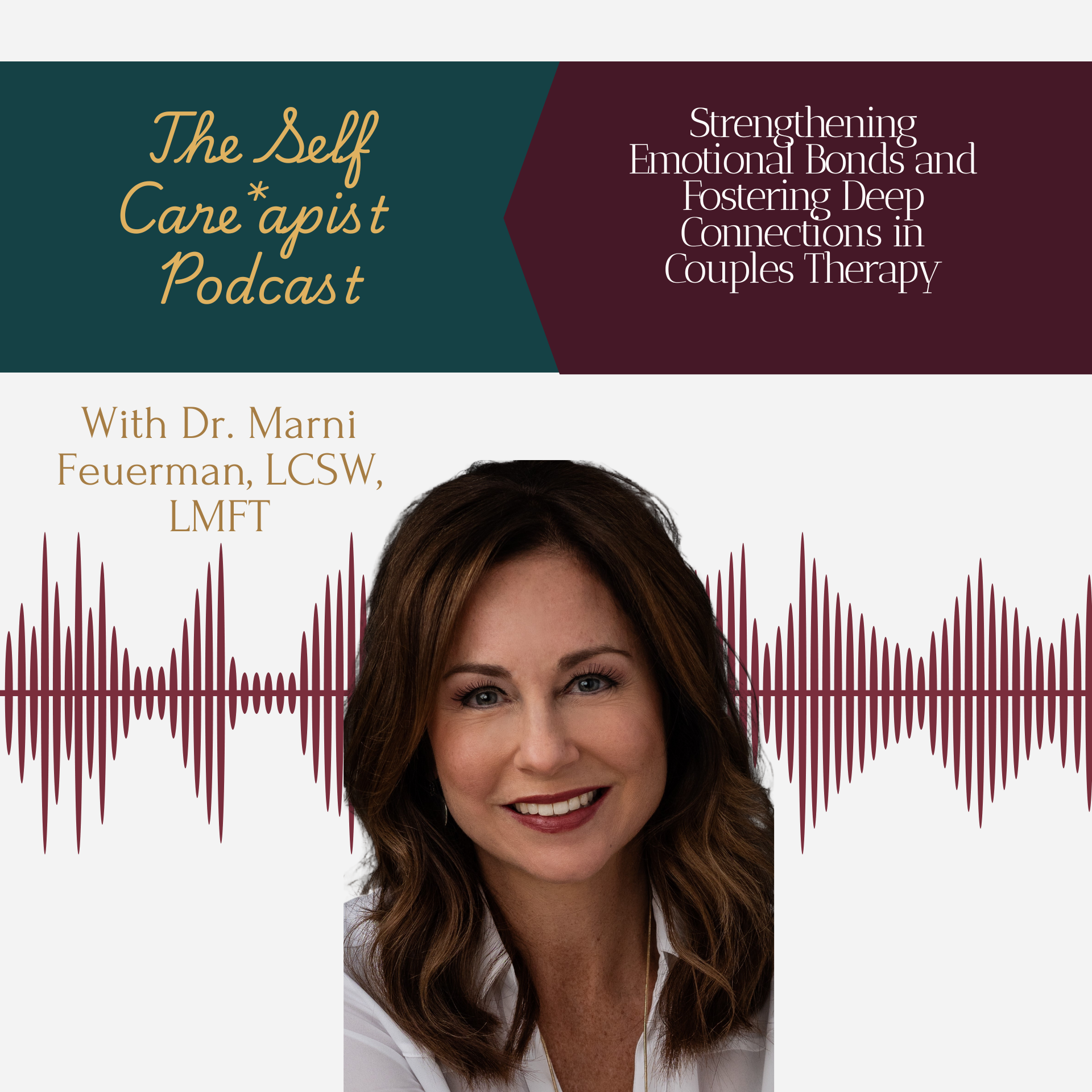
What does it really take to help couples create lasting connection? In this episode, Dr. Marni Feuerman joins me to explore strengthening emotional bonds in couples therapy and highlighting her extensive training in both Emotionally Focused Therapy (EFT) and the Gottman Method. Together, we examine how attachment, emotion, and experiential work shape real, enduring relationship change.
From session on, Dr. Feuerman shares how effective therapy helps partners start where they are and expand from there.
Training in EFT and Gottman: A Well-Rounded Foundation for strengthening emotional bonds in couples therapy
Dr. Feuerman reflects on her journey to certification in EFT and level three training in the Gottman Method. While Gottman offers extensive tools and psychoeducation grounded in research in their research lab The Love Lab, she found EFT to be a method that she calls on most frequently, as she appreciates the elements of emotional attunement and systemic change.
EFT now includes emotionally focused therapy for couples (EFCT), individuals (EFIT), and families (EFFT), making it a flexible and powerful framework.
Why Strengthening Emotional Bonds Requires Experience
One of the core insights Dr. Feuerman shares is the difference between talking about emotion and experiencing it. In EFT, therapy is experiential which means each client has opportunities to practice the skills in session, sometimes in enactments where partners speak directly to each other, with the therapist helping them stay emotionally connected and safe.
As she puts it, “We’re not just talking about sadness; we’re feeling it, processing it, and creating new neural pathways together.”
Starting the Work: Assessments and Emotional Safety
Dr. Feuerman outlines her early sessions with couples: thorough assessments, individual partner sessions, and a focus on understanding the couple’s cycle. She describes relying on her own assessment even more than the couple’s report of what’s happening and that helps her determine whether it’s high conflict, emotional distance, or a repeating pattern of shutdown and pursuit.
And if the work is better suited to individuals, she shares how and when to transition or refer out.
From Ghosted to Growth: Attachment, Patterns, and the Book Behind the Work
Excitingly to me, we discuss Dr. Feuerman’s book, Ghosted and Breadcrumbed, which synthesizes her clinical wisdom into practical guidance for women caught in dating patterns with emotionally unavailable partners. It’s a powerful blend of attachment theory, self-awareness, and action steps.
She describes that chemistry can be important and feel exciting, but it isn’t the only thing to look for and focus on, and describes a few of the necessary characteristics to look for in addition. She also mentions the book Becoming Attached as a great read when it comes to attachment.
Therapist to Therapist: Learn, Consult, Grow
Dr. Feuerman’s personal love of learning translates to the mission of The Self Careapist Podcast and she speaks directly to our therapist listeners: keep learning, pursue high-quality consultation, and don’t underestimate the value of experiential trainings. She encourages clinicians to explore both EFT and Gottman Method, and to find their own “fit” while centering client needs.
Why This Episode Matters
If you’re a therapist, a student, or a therapy nerd like us, this conversation offers insight, honesty, and some first steps if you’re interested in pursuing advanced couples’ training.
Tune in to hear how strengthening emotional bonds in couples therapy begins with emotion, unfolds in the room, and continues long after the session ends.
Check out the full transcript below:
Strengthening Emotional Bonds and Fostering Deep Connections in Couples Therapy with Dr. Marni Feuerman
Self Careapist Therapist: Expert Insights and Practical Therapy Skills
Host: Lorain Moorehead, LCSW, EMDR Certified Therapist Guest: Marni Feuerman, PsyD, certified Emotionally Focused Therapy therapist and supervisor, Gottman-trained couples therapist, South Florida
Training in EFT and the Gottman Method (00:00)
Lorain Moorehead: Welcome, Dr. Feuerman.
Dr. Marni Feuerman: Hey, great to be here.
Lorain Moorehead: I’m so happy to have you. I told you one of the reasons I was most excited to talk to you is your solid EFT and Gottman training background. Can you describe what the process has been like coming up the ranks in both?
Dr. Marni Feuerman: Sure. It’s a long, long process, especially doing two different things. I’ve been working with couples, and I love working with couples, so that was my focus, and I knew I needed additional training in couples therapy. I had always read a lot of the Gottmans’ books. Their books and research are excellent, profound. If you’re a bit of a psychology or therapy nerd, like a lot of us are, you read that stuff and think, wow, that’s neat. So I really liked it. Then I was introduced to emotionally focused couples therapy, which is Sue Johnson’s work. I pursued that all the way to certification and then became a certified supervisor, so now I also help therapists become certified in EFT. For Gottman, I got up to level three, and I feel the knowledge is really good. And of course I always recommend people be well-rounded.
I also got certified in discernment counseling, which is quite different. We don’t have to talk about that today, because it could be a whole other show, but it’s good for couples with ambivalence, where one person might be leaning out of the relationship and one leaning in, so divorce is on the table or their goals aren’t aligned. That’s also been helpful.
I’d tell people you’ll know what fits for you, because stylistically people are drawn to different methods. Some want to learn IFS, some want to learn CBT. You’ll see what resonates for you as a therapist, and EFT resonated for me. The other thing I felt was really important is that EFT has more outcome research showing it’s successful as a therapeutic approach. Gottman has a ton of research, but not as much outcome research, so there’s a bit of a difference. But both inform my practice, and I’d recommend looking into both.
Lorain Moorehead: The Gottman books do such a good job of giving psychoeducation and explaining what you’re seeing, based on the many studies they’ve completed themselves. Is it the Love Lab?
Dr. Marni Feuerman: Yes, the lab at SPU was fascinating, right?
Lorain Moorehead: It’s so cool. And it sounds like when you were introduced to EFT, that felt like the modality you could take and run with in your work.
Dr. Marni Feuerman: Yes. And over the last few years, EFT has expanded to work with individuals and families, and I love that too. It was easy to segue into those. If you think about it, even when people come for individual therapy, you’re doing systemic work, because you’re thinking about that person in relation to all the other people in their life. So you want a systemic framework. Gottman’s work and research is geared more toward romantic married couples, and they’ve done some things to expand it to singles. But I think the systemic framework and training EFT offered was much more expansive, and I find that really useful in practice.
Lorain Moorehead: That makes a lot of sense. We don’t have one type of client or even one type of couple. Even friendship therapy is becoming a bigger thing.
Dr. Marni Feuerman: Yes, exactly.
Lorain Moorehead: What are the different abbreviations we might see for types of EFT?
Dr. Marni Feuerman: Do you mean EFCT or EFIT? It started out as just EFT, emotionally focused therapy. When they expanded to individual and family work, they added letters to distinguish them. EFCT is emotionally focused couples therapy, EFIT is emotionally focused individual therapy, and EFFT is emotionally focused family therapy. You’ll see those floating around.
Unlearning and the Case for Experiential Therapy (05:50)
Lorain Moorehead: That’s great to know. What, if anything, would you do differently if you started your career over?
Dr. Marni Feuerman: The only thing: EFT is a model that uses a lot of emotional depth, and it’s experiential, very different from a purely cognitive method. So I probably would have tried to learn an experiential or process-experiential approach earlier. Coming out of school I learned a lot of CBT, which is excellent for certain populations and conditions. I’m in no way poo-pooing any of these or saying they’re not good. It’s about what resonates for you as a therapist and, most importantly, the population you’re working with: who you’re working with, the best approach to help them, and what’s in your skill set. But I had to unlearn a lot of strategies geared toward CBT and cognitive approaches, and also solution-focused work. I did learn a little psychodynamic, which was maybe the closest cousin to the process-experiential and emotionally focused approaches, so that was helpful. But when you’ve been training and training in other models and then fall in love with a new one, there’s a good chance you’ll have to unlearn some things. That was my situation.
Lorain Moorehead: By experiential, do you mean that during the trainings you go through it yourself, similar to what happens in EMDR or brainspotting?
Dr. Marni Feuerman: Experiential means the therapy session itself is an experience designed to create change. In EFCT, here’s a quick example. If I’m working with someone, I’m trying to get them to feel the feelings they’re talking about, to bring them up in the session, and to expand and deepen them. Say it’s sadness. It’s okay for me to linger with the person in the sadness, and if it brings tears to their eyes, comment on it. Allow them to have the experience of sadness in real time in my session.
With couples, there’s a piece called an enactment, another way I create change experientially. It’s always a little easier to talk to the therapist. Say the sadness you’re experiencing is because you feel rejected when your spouse shuts down. I may have you turn to your partner and say: you’re telling me so much about the sadness; I’d love for you to turn to your partner right now, look in their eyes, and talk about the sadness. Then I process that encounter, that enactment. There are different ways to process it based on the partner’s response. But it’s an actual experience. They’re not just talking to me. They’re talking to their partner, and that creates deeper change, because they’re going through it and doing it instead of talking about it from a cognitive place.
The example I give a lot, which may help therapists listening: think about learning a sport, golf or tennis, or learning to ride a bike. If I explained how to do it, you’d only have a cognitive understanding. When we go out on the tennis court, or get on the bike and ride, it’s a totally different thing. It takes practice, muscle memory, procedural memory. That’s one of the key ways change happens in people and relationships. We don’t just want them to talk about riding the bike. We want them on the bike.not just talking about their sadness from a cognitive place, but learning how to speak to their partner, and we want to help the partner know how to receive and respond to that.
That’s the experiential part. When I say process, I mean present process: what comes alive in the session. I work in a process and experiential way as much as possible in the session. We’re certainly not doing it the entire session, which would be very difficult, but we spend a significant amount of time that way.
Lorain Moorehead: That explanation makes so much sense. You’re accessing a different part of the brain. When someone leaves having gone through it, they feel those connections in their bones. They’ve made new neural connections, and they leave not thinking, here’s what I’m supposed to say, but feeling that new process.
Dr. Marni Feuerman: Exactly. Think about it: when clients go home, if we’ve only taught them something verbally, it goes out the window when people are really emotional. In EFT we want to harness emotion and use it, in a very directive way, because we want people to learn about their emotional worlds, how they get triggered, why they do what they do, and what moves they make. If we just said, when you’re home and you’re sad with your partner, tell them with an I statement, that isn’t bad or wrong. But when people get hijacked, the rational part of the brain is often offline, so they can’t access the wonderful thing you taught them. If you took them through it in session, it’s in the bones, muscle memory, and they’ll most likely be able to draw on it in real time at home. Sometimes you have to repeat it several times, but they can draw on it in a way they might not if it had only been taught cognitively.
Assessment and Mapping the Negative Cycle (13:37)
Lorain Moorehead: So neat. How do the initial sessions set the pace for this work? Sometimes clients come in with pretty high conflict and pretty ingrained patterns.
Dr. Marni Feuerman: As I’m sure you know, every client and every couple is different. Even when people try to tell me what the issue is on the phone or in the first email, I ignore it entirely, because they don’t know what’s going on. That’s why they need help, someone to take the aerial view and guide them. So when they first come in, I’m really thorough with the assessment.
With EFT, and I believe with Gottman as well, and I’d highly recommend this whatever your approach, you see the couple first, and then you see each partner individually one time. That way you get a lot of information about their history, family history, and dating history, and maybe things they’re not as comfortable sharing in front of their partner but that are essential for you to know. You may also rule them out as candidates for couples therapy depending on what you learn. If they’re determined to be good candidates, I work with them together pretty much the whole time after that. I don’t separate them out again.
Then I usually give them some feedback and an idea of what we’ll be doing and the rationale. I don’t give a whole lot of information, because I can explain it or I can do it, and if I’m using the session to explain, we’re not doing the therapy. Some couples are highly distressed, with a very chaotic cycle, and with them I’ll sometimes say: I’m not trying to be a jerk, but you’re here because you need help, so I may interrupt, slow things down, and insert myself at times so I can be truly helpful. So sometimes I give a little information about the structure. Other couples follow along nicely and let me take it where it needs to go, and you get every gradient in between.
I don’t give homework necessarily, but if people want it and will do it, I’ll have them read books, like Hold Me Tight by Dr. Sue Johnson, or some of the Gottman books geared toward a lay audience, between sessions. I love when they come in with insights from what they’ve been reading. That’s really helpful too.
The main thing I’m trying to delineate is their negative pattern. I don’t want to blame either person for the problem, I look at the relationship itself as my client, the in-between; I always say: I’m going to look at what’s going on between the two of you, the interaction. You’ll learn and grow a lot psychologically yourself, and it will also help your relationship. So I’m trying to see who pursues or escalates, who withdraws or avoids. Do they both avoid, so nobody talks about anything and they’ve grown into the roommate zone? Are they both explosive? Are they both attacking and blaming? How does the pattern and cycle look? I’m trying to gauge that, and their protective moves, as we call them. Some people have behaviors that are protective but fuel the cycle. Someone might shut down because they’re overwhelmed, or because they feel they can never get it right with their spouse, so they decide not to say anything at all. I’m trying to unpack those things for the couple and hopefully shift that dance to a much healthier one.
Individual EFT and Bringing a Partner In (18:45)
Lorain Moorehead: Great explanation. Do you see individuals in your practice?
Dr. Marni Feuerman: Yes, I do some individual therapy as well. I’m more on the eclectic side and use different approaches, but I do a lot of emotionally focused individual therapy, which has a lot of crossover with what I do with couples. There’s no enactment with a partner, but we do something called encounters, which in a nutshell are imagined conversations. It could be with a parent, a spouse, a friend, a part of self, an inner child part. These imaginal conversations help them problem solve, and also keep their emotional balance when they start to feel dysregulated or thrown off balance. It’s very useful.
Lorain Moorehead: Do you ever have individual clients ask to bring a partner to one session, or to have them join periodically?
Dr. Marni Feuerman: Every situation is a little different, so it depends. If I can catch it early, I will. This happened pretty recently: a wife came in, and after the first two sessions, the assessment and one session, I said, this is really a relational issue, a marital issue, and I think we could go so much further if you brought in your partner. Is he willing? You get all kinds of answers. Some people say he never would. I try to coach them on how to ask, if they’ve never brought it up. This person went back and asked, the partner was very willing to come in, and we switched gears very quickly.
But if I’ve been working with someone for months, it isn’t great to pivot like that, because the alliance is built up with the primary client, and it often doesn’t go well. In that case I’d offer a referral: it seems like you could benefit from someone looking at this relationship and working with you both. Are you willing to do that? Then there are cases where it’s primarily individual work, but what I’m hearing tells me it would be good to get collateral information. That’s what we call it. The other person isn’t the client, and you’re not working with the whole system, but you’re getting information to help you help the client, because someone else’s view, especially someone they interact with a lot, can be so helpful in understanding what you’re dealing with or what goals to set. Again, the initial assessment will help you know which direction to go.
Lorain Moorehead: I think that parameter is really helpful for clinicians listening. If it’s at the start of the work, bringing in a partner can be safe and appropriate. If you’ve already done a lot of work and would now be integrating someone, it might be more helpful and safer to refer the whole unit out.
Dr. Marni Feuerman: Right, exactly. I totally agree.
Lorain Moorehead: There are a lot of reasons for that, but after you’ve established that close therapeutic relationship with a client, a partner joining is going to feel like a third wheel.
Dr. Marni Feuerman: Yes. Even if you’re really good at navigating bias, you don’t want to be accused of it. And it’s difficult, because I want to honor the client’s view. If someone comes in saying, I kind of think you’re taking my wife’s side because you’ve been seeing her for four months before I came in, you can’t unring that bell. It’s better to start on a level playing field. Otherwise you’re at high risk for that, and you’re much better off letting them start with someone new, where they’re a blank slate and it doesn’t affect the alliance. In all methods, no matter which we’re talking about, the alliance is absolutely critical. If the alliance is off, no matter what approach you use, it’s not going to flow well. You always have to address an alliance issue before anything else, and if someone accuses you of being biased or taking sides, you’ve got one on your hands.
Writing as Part of a Clinical Career (24:21)
Lorain Moorehead: A great summary. In addition to all the rich clinical work you’re doing, you do a lot of other things day to day. You’re a speaker, an author, a writer. Can you tell us how you got into that and what it fulfills for you, for anyone interested in that path?
Dr. Marni Feuerman: Sure. There are several purposes, but I always liked writing. It was a hobby. In school I liked writing papers, which I know seems nerdy, and of course I like reading. So I started blogging on my own website, and then I started writing for a site called YourTango, which helps get your blogs onto their site and sometimes syndicates them. I had a lot of success with that, and then About.com found me (I’m not exactly sure how) and hired me as their marriage content writer. About.com was super popular. It’s not around anymore, because they divided it into about eight different websites. I did that for a while, and I just really liked it.
The other thing it did was create a content marketing strategy for my website. All the keywords I want to show up for, in the work I do, show up organically on Google because I have so many original blogs. Original meaning not AI; when I wrote all those blogs, AI wasn’t around. Not that I don’t think AI has a role. It can help you plan content. But Google is starting to tell the difference. As therapists, you have an education and a lot to offer, and putting your knowledge out there in written form really helps you be found online and seen as an expert.
From there I did a lot of media contributions, and it all worked synergistically. Once in a while I’ll do presentations, or interviews like this one, or webinars for professionals. I’ve done Hold Me Tight workshops for couples, based on Sue Johnson’s work. And eventually, when you write a lot, one of your dreams is to write a self-help book. In 2019 I wrote one geared toward women who find themselves in repetitive patterns with unhealthy or unavailable men. The book helps women figure out what’s going on, how to get out of that circumstance, and what a healthy relationship looks like, so they can gain insight into why they keep getting stuck in this pattern.
Ghosted and Breadcrumbed and Earned Security (27:57)
Lorain Moorehead: As you know, I really enjoyed the book, Ghosted and Breadcrumbed. One thing that was refreshing is the clear approach to what to look for and how to see certain things in relationships for what they are, like a lack of effort. You tie some of it to attachment styles, and you’re direct about what you see, what the possible outcomes are, whether there’s opportunity for positive outcomes, and what it would take to get there.
Dr. Marni Feuerman: Thank you so much. I’m in no way saying these circumstances are hopeless, but you need someone who’s also willing to take feedback and do the work with you. It’s certainly possible to reach what’s called earned security. If you have an insecure attachment style and your partner does too, it doesn’t mean you can’t get to earned security together.
The biggest problem I was seeing is that someone, a woman especially, keeps trying harder and harder, molding herself to fit a person, or thinking her love can help or fix them. I want women to recognize unavailable partners and know when to cut ties and walk away, or how to approach it and see whether the person is willing to do something about it. So, how to communicate effectively, assertively, and directly. It’s discerning what’s in front of you and what situation you have. And maybe why: why are you drawn to these types of people? There are often clues in someone’s background, in what’s happened to them, trauma, family-of-origin material. I want people to connect the dots about why they might be drawn to, or feel familiar and comfortable in, those situations.
The book goes through identifying those types of people, identifying what might be going on in yourself, understanding what a healthy relationship looks like, and setting goals to get there. I wanted it to be heaviest on solutions, on how to get from a bad place to a better place, because I find a lot of self-help books describe the problem over and over, like 80% of the book. I spend some time describing the problem, but a lot more on what you can do about it.
Lorain Moorehead: How much do you incorporate that identifying work into your couples sessions? How much of the book’s principles show up in your sessions, or vice versa?
Dr. Marni Feuerman: Both. The book is a product of reverse engineering in a way: what I know, and what I’m trying to help couples and individuals get to. Whether it’s Gottman, EFT, or other research, we have a lot of good information now. We have better science and more knowledge about love and what makes relationships succeed and fail. So I’m working backward a bit with people, especially someone who hasn’t chosen a partner yet. I want them to make a better choice, because committing to a partner is one of the most important decisions you’ll make in your life. If I can help people make better choices, I’m happy I’ve contributed to that.
The protective strategies people have show up individually, in dating, and in relationships, so whoever I’m working with, I’m looking at that. Attachment gives us a good chunk of the answers. I wouldn’t say it’s everything, and attachment can have some flexibility depending on who you’re with. We all know some people bring out the worst in us and make us feel anxious or off balance, while someone else can make us feel really safe and secure. So I use it in both directions: understanding how attachment security works and working backward from there, whether with a couple or an individual.
Lorain Moorehead: Is there any attachment research or literature beyond what’s incorporated into Dr. Sue Johnson’s work that you’d recommend for becoming more familiar with these techniques?
Dr. Marni Feuerman: I’ve read quite a few, though I’m not sure I’ll get all the titles right. One I read is, I think, Becoming Attached by Robert Karen. That’s probably one of the best at summarizing a ton of the research. There are also researchers who aren’t clinicians publishing articles, and there’s always new material coming out. And there’s a lot of crossover with psychologists and scientists doing interpersonal neurobiology work. Attachment falls under that bigger umbrella as well.
Lorain Moorehead: Great. I’ll link all of these in the show notes.
Chemistry and Red Flags (34:39)
Lorain Moorehead: I see a lot of high-achieving career and entrepreneurial clients, and many are still dating. It can be a struggle to discern what’s important in what they’re looking for. Chemistry is a big one, because it feels like it has to be at the top of the list, and you address this in the book. Can you explain your perspective on chemistry? How much do we need, and how do we attain it in a way that’s healthy long term?
Dr. Marni Feuerman: The funny thing is that even Gottman, with his extensive arsenal of research on relationships and the predictors of divorce, has said there’s no way to predict chemistry. You could have two people who look like a phenomenal match on paper, get together, and have no chemistry.
Do you need it? Yes, because it helps create some of the glue that holds you together, and attraction feeds into chemistry. Imagine being with someone you weren’t attracted to. Evolutionarily, attraction is what has kept our species going.
Lorain Moorehead: And it keeps people hanging in there and staying present.
Dr. Marni Feuerman: Right. So if that’s missing, it’s very problematic. But here’s how I’d put it: you should feel some chemistry, but not at the expense of all the other necessary ingredients for a healthy, stable relationship. If you have chemistry and you also feel safe and secure, and the person is consistent, reliable, caring, and empathic, showing up and present, someone you can count on, you’re absolutely going to need all of that too. If you have chemistry without any of that, I’d say extreme caution, because we know those are the things a healthy, thriving relationship requires.
The other thing: do some personal work if you’ve been exposed to overwhelming or difficult circumstances earlier in life, because you don’t want what you’re calling chemistry to be your attachment system activating because something feels familiar or comfortable. If you had an abusive parent and learned to love alongside abusive or unkind behavior, when somebody isn’t nice to you, or is mean or abusive, you may think that’s how it’s supposed to be or how you’re supposed to feel. That’s where it gets really tricky.
I want people to parse that out and understand that certain things come alive and, as I say in the book, run the show from behind the scenes. It gets stuck in our implicit memory, so we’re drawn to some of these circumstances and label it chemistry when it could be clouded by something else. I want people to be very clear about that, and certain that they need other things besides chemistry. We’ve all heard that love is not enough, and it’s true. Otherwise a lot more people would make it, and they often don’t, because of negative traits and ways of interacting we know doom relationships.
Lorain Moorehead: We see this a lot: what feels like, or gets explained as, chemistry often looks like a reward system. Like Pavlov’s dogs: I’m getting attention after someone was unkind to me or withdrew from me, so my blood is pumping, I’m so excited, I feel so wanted. That’s chemistry, I like that feeling. And it’s replaying family-of-origin patterns established long before this connection.
Dr. Marni Feuerman: Yes, 100%. And as you said, it can even feel addictive. It activates the same kinds of chemicals in our brain.
Lorain Moorehead: I’d be remiss not to ask a follow-up. How early do your clients feel chemistry with someone new, and how much would you weigh in on someone considering not seeing a person again because the connection isn’t instantly there?
Dr. Marni Feuerman: Oh boy. From my knowledge and what I’ve read, I think women usually have a little more flexibility and are willing to wait a little longer to see if chemistry develops. I find that’s really difficult with men: if they don’t feel it instantly, they’re done. They’re not going to see what happens.
You can have significant attraction and chemistry very early. I’d say take it at face value. It’s okay to say, yes, this feels really good. Don’t necessarily label it love, or decide this person might be your soulmate. I wouldn’t go that far. Just say, we’ve got chemistry, it feels good, I’m really attracted to this person and they seem attracted to me. I won’t take that feeling away from anyone. We all want to feel that way. But slow down enough to figure out who this person is. Are your values aligned, showing up consistently, responsible and reliable, making you feel safe? Without love bombing you, calling you 50 times a day? What are you learning from their behavior, not just from what they say?
I also mention in the book that people who are narcissistic, whether narcissistic traits or full narcissistic personality disorder, attract people right away too, because they exude chemistry or charisma. They’re usually good-looking, not a hair out of place, dressed really stylishly. But you could have a person who isn’t available to you at all, isn’t going to treat you right, is going to bring you down, try to take you down, and isn’t empathic. So you’ve got to see what’s behind the curtain and really get to know the person. I hope for everybody that strong early attraction and chemistry turns out to be what you think it is and grows. But don’t deny red flags when you see them, and don’t downplay it when you learn something that doesn’t align with you, your beliefs, or your way of living. Honor yourself and what you’re hearing. Take what they tell you and what their behavior shows as the truth, and don’t assume those things will change.
Lorain Moorehead: You said something so important: not just what they tell you, because people’s ability to self-report is pretty limited. Someone might say, I’m this type of person and this is how I show up. But just as we want to assess ADHD across settings, until you’ve seen a prospective partner in action across different settings, we don’t want to go only by their personal description.
Dr. Marni Feuerman: Yes, and get trusted others’ views too. If you have a good friend whose judgment you trust, or a parent you have a good relationship with, see what they say. They’ll often see something you don’t, because you’re caught up in the feelings, in what’s called limerence, the early phase of the relationship.
Advice for Couples Therapists (44:39)
Lorain Moorehead: Is there anything you’d like to see clinicians who work with couples do more or less of?
Dr. Marni Feuerman: Always keep learning. Even though I’m a supervisor, I still learn from people who are even more highly trained than me, and from people trained in a compatible model or approach that fits with what I’m doing with a couple. So be open to learning, be a lifelong learner, and get the best supervision or consultation you can afford. For people who are already licensed, it’s consultation. It keeps you grounded. And we have to unload. This work is hard. Being a therapist is hard, and working with couples is ten times harder. It’s good to consult with another therapist, maybe someone with more training than you. I still do it, so I recommend it. Those are my two wishes for people: keep learning, and get good consultation.
Lorain Moorehead: If I were asked that, I’d probably give the exact same answer, because that’s the whole mission of Self Careapist Therapist: exposing people to what’s available to learn. Just like you said about EFT and experiential models, we come out of school steeped in the models our school and professors know well. Getting further out and saying, I could do this, these folks are doing that, I want to explore it more, is so valuable. And supervision is huge. Twenty years ago I didn’t realize it was possible to consult with someone beyond what my agency or center provided. Some of the consultation I’ve done for EMDR is the most valuable work I’ve ever done, because someone was watching my sessions.
Dr. Marni Feuerman: Absolutely. Taping, and having session recordings so the person you consult with sees exactly what you’re doing, is really helpful. I know it takes a lot of bravery and vulnerability. I did it, believe me, and I have a lot of compassion for therapists who do it. I do a lot of consultation too, and I’m really proud of the therapists who show their work and put themselves out there. You’re getting direct feedback on your work, and you’ll improve. It’s like a good therapeutic relationship you can have with your consultant, and I’d put it squarely into self-care as a therapist.
First Steps for Learning EFT and Gottman (48:24)
Lorain Moorehead: For people listening who are curious about getting into some of what we’ve talked about, what would you recommend as first steps?
Dr. Marni Feuerman: If you don’t want to take a big, expensive leap, there are very good books. A general one by Sue Johnson is, I want to say, Attachment Theory in Practice. Gottman has clinical books as well; one is called The Marriage Clinic. Start by perusing some books, see what resonates for you as a therapist, and then take some actual training. You can easily do Gottman Level 1. The EFT externship is four days, and I think they have a one-day fundamentals class too, through ICEEFT, the parent organization for all EFT trainings. The Gottman Institute has all the resources for the Gottman Method. So I’d say take the basic trainings of both. To me, nothing compares with being in a live training, as opposed to reading a book or watching a recording. Both trainings have role-play pieces. I know a lot of people don’t like role-play, but it’s the best way to learn: they teach a skill, you practice it, and you get it in your bones. You can’t go wrong. You won’t be wasting your time or money. You’ll always use that education, whether you work with individuals, couples, or both.
Lorain Moorehead: And for folks further along in EFT, it sounds like they could contact you for consultation. Is that right?
Dr. Marni Feuerman: Yes, I do regular consultation. I’m an ICEEFT certified supervisor, and I help people get certified in emotionally focused therapy.
Lorain Moorehead: And your practice is in Florida.
Dr. Marni Feuerman: Yes, I’m based in South Florida. My psychotherapy website is thetalkingsolution.com, and another website with my books and other material is drmarnionline.com.
What She Is Watching and Self-Care as a Longer Arc (51:15)
Lorain Moorehead: Great, I’ll link all of that. My final questions, which I love asking everybody. First: is there anything you’re consuming right now, media, food, or otherwise?
Dr. Marni Feuerman: Yes, I’m watching Dexter again, the new Dexter that just came out, Resurrection.
Lorain Moorehead: I didn’t realize that had started. I watched all of the original. Good to know.
Dr. Marni Feuerman: Good, it just started recently, so I’m enjoying that. I know this may seem weird, but I like true crime. It’s probably my psychology brain, interested in the criminology side of things. I love to keep reading psychology books, and once in a while I’ll read a memoir. Everybody’s bothering me to read fiction, so I need to get a good fiction book on my list. For fun, I like to cook, work out, and do yoga, hang out with my family, and play with my dog. All good stuff.
Lorain Moorehead: Is there anything beyond that list that you do for self-care, or recommend for your clients’ self-care?
Dr. Marni Feuerman: What I’ve been learning, and what makes a lot of sense, is that self-care isn’t just, hey, go get a massage. People have to change their mindset, and it’s a slow wind-down. I’ve had to do that too. Things like limiting my schedule, because how great am I going to be if I’m seeing 10 couples a day? You only have so much bandwidth and energy to give. That’s a shift in how you see the world and frame things. What I tell clients is that if your goal is better self-care, it’s a journey to get there. What will we have to wind down, eliminate, or reprioritize? Where will we no longer spend time, and where will we spend more time, because it fills you up and energizes you? This could take many months. Self-care isn’t just paying for services to get pampered, though those are great too. When we talk about self-care psychologically, I think we’re talking about a longer-term goal, getting people to where they’re not maxed out, burned out, and exhausted, with objectives plotted out over time.
Lorain Moorehead: You explained that really well. Sometimes it’s about seeing the big picture, because if you’re draining so much over here, doing something over there might feel good without leveling out what’s happening.
Dr. Marni Feuerman: Right, absolutely.
Closing (54:47)
Lorain Moorehead: Is there anything else you want to share, or that feels important to say as we wrap up?
Dr. Marni Feuerman: Just thank you so much for having me. I love the concept of the podcast: talking to other professionals about their work, and about self-care and balance and all these important topics we all need. I think you’re doing a great service to therapists by talking about this.
Lorain Moorehead: Thank you so much. I’ve been looking forward to this interview, and I’m so excited you were able to be here today. Thank you.
Dr. Marni Feuerman: Great, thank you. I really appreciate it.


+ show Comments
- Hide Comments
add a comment