

Maybe you have had a client who interrupts you four times in fifteen minutes, reframes feedback as an attack, or spends most of the session either boasting or denegrating. A lot of clinicians simply avoid taking these referrals or echo that therapy isn’t effective for these folks.
That is the clinical territory Wendy Behary, LCSW, has worked in for three decades. She was part of the original team under Dr. Jeffrey Young that developed schema therapy in Manhattan, and was assigned early on to help adapt the model specifically for narcissistic clients, after she kept reporting how intimidated and reactive she felt in session with them. She has since built a career treating narcissistic clients, their partners, and couples together, and wrote Disarming the Narcissist from that work.
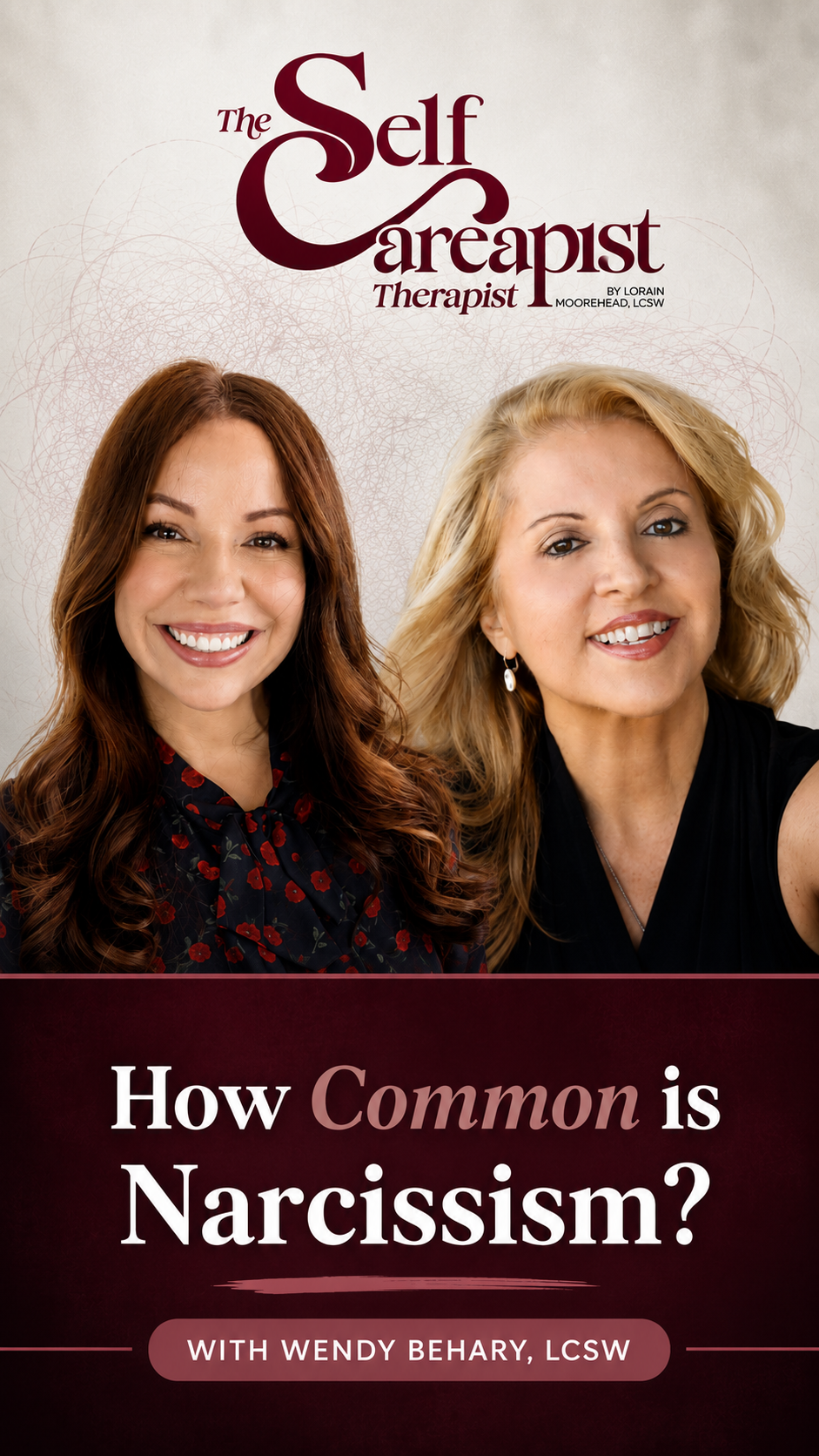
Recently, I had the opportunity to interview Wendy on Self Careapist Therapist Podcast, where we discussed what social media gets wrong about narcissism, the clinical difference between its overt and covert presentations, and the specific technique she calls empathic confrontation.
Most of What You’re Seeing Online Isn’t Narcissism
Before any treatment planning, Behary draws a differential line most social media content skips entirely. “Often what we’re seeing is not necessarily narcissism, but antisocial personality, psychopathy, sociopathy, and not narcissism,” she said. Narcissistic traits sit on a spectrum, and plenty of clients present with a moderate degree of them without meeting criteria for the personality disorder. The internet’s version, incapable of empathy, dangerous, unreachable, describes something closer to psychopathy. It is not a clinically useful description of the clients actually walking into your office.
The Model: Schema Therapy and Modes
Schema therapy grew out of CBT and attachment theory, and Behary describes it as integrative rather than eclectic: it draws deliberately from other evidence-based approaches in service of one goal, meeting a client’s core unmet emotional needs through a corrective emotional experience.
A schema, in this model, is an early belief formed in childhood, carrying real emotional weight and easily reactivated by memory: no one will ever be there for me, I’m defective, people are going to hurt me. There are 18 of these early maladaptive schemas. What determines diagnosis is not the schema itself, since most humans carry several, but the survival mode a client learned in response to it.
For a narcissistic client, Behary explained, the underlying schema often includes real defectiveness and insufficient love or acceptance. The narcissistic presentation, the bravado, entitlement, approval-seeking, is the overcompensation mode built on top of that. Partners of narcissistic clients frequently carry the same underlying schema and cope in the opposite direction: self-silencing, subjugation, people-pleasing.
Overt vs. Covert: The Distinction That Changes Your Assessment
This is the nugget most likely to change how you consider a client. The overt, grandiose presentation is the one clinicians recognize immediately: confident, showboating, drawn to leadership and status, low neuroticism. The covert presentation shares the same core entitlement and low empathy, but can be more difficult to recognize since it looks like suffering.
“The covert narcissist gets their extraordinariness from being a victim. Whereas the overt type gets their extraordinariness from all their wonderful achievements, acquisitions, accomplishments.” Wendy Behary, LCSW
Behary calls this presentation the “virtuous victim”: nobody appreciates me, I do everything, nothing is ever good enough, a need for reassurance that cannot be satisfied because being unappreciated has become load-bearing for the client’s identity. It is also, she noted, harder to catch in women specifically through the parenting relationship, where the presentation can look like devotion (redecorating a daughter’s apartment unasked, then feeling wounded when she says it seems controlling) rather than the grandiosity that therapists might notice more readily.
Can These Clients Actually Access Empathy?
Behary’s answer complicates a claim you have probably heard stated as fact in a training or on a forum. “Empathy is not about agreement,” she said. “A lot of times it’s not agreement, it’s just, I get it. I get how you are the way you are. I don’t necessarily agree with it, I don’t like it, but I get it.” Most people, narcissistic or not, confuse empathy with kindness or sympathy, which makes it a harder skill than it looks for any client.
For a narcissistic client specifically, empathy is blocked, not absent, and it is blocked by shame. Getting there is an inside-out process: the shame and defensiveness have to be addressed before there is capacity left to attend to someone else’s inner experience. That is also the line between a real apology and what Behary calls a narcissist’s non-apology, I told you I’m sorry, what’s your problem. A workable apology has three parts: owning the behavior, imagining concretely how it landed for the other person, and committing to change. Clinically, that third piece rarely lands until the shame work is far enough along.
Empathic Confrontation: The Technique Itself
Empathic Confrontation is a specific skill, not a general attitude of patience. It means holding a limit and validating the underlying experience in the same sentence. Her example, delivered to an interrupting client: I know you have a lot to say and I know you want me to hear it, but you’re interrupting me. Remember we both agreed that we both get to be respected.
Every limit is paired with a line that heads off the client’s core fear of criticism: this is not meant to be a criticism, I’m not saying you’re a bad guy. Behary is direct that this cannot be confused with being permissive. “I’m not soft at all,” she said. “I’m soft on the vulnerable side, but I’m not soft on the narcissistic modes.” The confrontation is clear and the empathy is clear, and can be used on different targets in the same conversation.
Getting Sturdy: Managing Your Own Activation
Behary is candid that this population can trigger a clinician’s own vulnerability, and that regulating your own state has to happen before any technique works. Her practice: before session, she imagines sending her own vulnerable part somewhere safe, so it is not the part of her sitting across from an escalated client. She calls it a dress rehearsal.
In the moment, the tool is simpler than it sounds: “I need a minute.” A stated pause, taken out loud, before reacting from an activated place. Done consistently and early in treatment, the leverage that brought the client in the door (a marriage, a job, a relationship with an adult child) starts to transfer onto the relationship with the therapist. That transfer, in Behary’s experience, is usually the actual turning point.
Leverage: Why Treatment Stalls Without It
Behary names leverage as one of the two prerequisites for treating this population at all, alongside a therapist’s own sturdiness. Without something the client genuinely does not want to lose, “it’s really hard to get the ball rolling. It’s hard to get traction.” Most narcissistic clients do not arrive by their own initiative; they arrive because a partner, employer, or family member set a consequence. Agreeing on that motivation and returning to it as needed is what keeps a client in the room long enough for the deeper work to happen.
What Change Actually Looks Like
Behary puts a real number on outcomes: roughly 30% of her narcissistic clients reach what she considers meaningful, sustainable change. Not a personality overhaul; nobody changes completely. What shifts is frequency and intensity: faster recovery from a trigger, a lower ceiling on the activation, longer stretches without a blowup. For a lot of partners, she said, that is genuinely enough.
The clients who do not sustain change are usually the ones where leverage evaporates, or where the work stayed behavioralwithout the internal work behind them. “When you get triggered, all bets are off,” Behary said, “until you do the deep internal work.” Part of that work is rescripting the client’s internal “demanding critic” through imagery, returning to the child who first absorbed the pressure to perform and giving that child room to be imperfect, scared, or comforted instead.
For Couples Work: Coaching the Partner Without Erasing Real Progress
When Behary treats couples, she coaches the partner on a specific bind: acknowledging real change without pretending everything is resolved. Her framing for partners: I really appreciated it the other night when you asked how I was doing. I see the signs that you’re trying, and I know we still have distance to go. Withholding all acknowledgment, she has found, can read to the narcissistic client as confirmation that nothing they do will ever count, which removes exactly the motivation treatment depends on.
Key takeaways for your next session
- Screen for antisocial or psychopathic traits before assuming narcissism. The internet’s version of “no empathy, unreachable” usually describes a different clinical picture entirely.
- Empathic confrontation means pairing a held limit with a line that addresses the client’s fear of criticism, in the same sentence. Neither piece works alone.
- Regulate your own activation before the client’s. A stated pause (“I need a minute”) protects the work more than powering through does.
Frequently Asked Questions
What’s the clinical difference between covert and overt narcissism?
Overt (grandiose) narcissism organizes around achievement, status, and confidence, the presentation most clinicians are trained to recognize. Covert narcissism shares the same underlying entitlement and low empathy but organizes around victimhood: a genuine, unresolvable sense of being unappreciated. Covert presentations are more likely to be missed in assessment because they read as suffering rather than grandiosity.
Is narcissism as common as social media suggests?
According to Wendy Behary, a large share of what circulates online as “narcissism” better describes antisocial personality or psychopathy. Narcissistic traits do exist on a spectrum and appear in mild forms fairly often, but severe, relationship-impairing narcissistic personality is less common than online content implies.
Can narcissistic clients actually build empathy in treatment?
Yes. Empathy in these clients is blocked by shame rather than absent entirely. It becomes more accessible once the underlying shame and defectiveness have been addressed directly, since the client’s attention is otherwise oriented toward performance and comparison rather than another person’s inner experience.What does “leverage” mean in treating a narcissistic client?
Leverage is something the client genuinely does not want to lose, a marriage, a job, a relationship with an adult child, that motivates them to stay in treatment and tolerate confrontation. Behary considers it a prerequisite for the work: without real leverage, there is little to interrupt the client’s default coping mode.
How much does narcissistic personality actually change in treatment?
Behary reports roughly 30% of her narcissistic clients reach meaningful, sustainable change, defined as faster recovery from triggers and lower-intensity, less frequent activation rather than a full personality shift. That outcome depends on sustained leverage and internal work, not behavioral coaching alone.
Listen to the Full Conversation
This post captures the clinical framework, but the full episode on the Self Careapist Therapist Podcast goes considerably deeper. Wendy and I also discuss:
- How narcissism can present differently in women, and why it is often spotted first through the parenting relationship
- What to do, session by session, when a narcissistic client walks out or no-shows
- How Behary coaches clients out of narcissistic dating patterns, and what partners should watch for in themselves, not just their date
Listen on Apple Podcasts · Watch on YouTube · Listen on Spotify
Clinical Consultation
In addition to providing EMDR therapy and clinical supervision, I offer case-specific clinical consultation for therapists navigating personality-disordered clients, including narcissistic presentations, in their own caseload.Learn about clinical consultation Lorain Moorehead, LCSW, EMDR Certified Consultant, PMH-C, Clinical Supervisor.
Self Careapist Therapist Podcast: Expert Insights and Therapy Skills is a therapist-to-therapist continuing-education podcast featuring researchers, authors, and practicing clinicians on evidence-based modalities, clinical interventions, and the practical application of therapy skills in real sessions.


+ show Comments
- Hide Comments
add a comment