

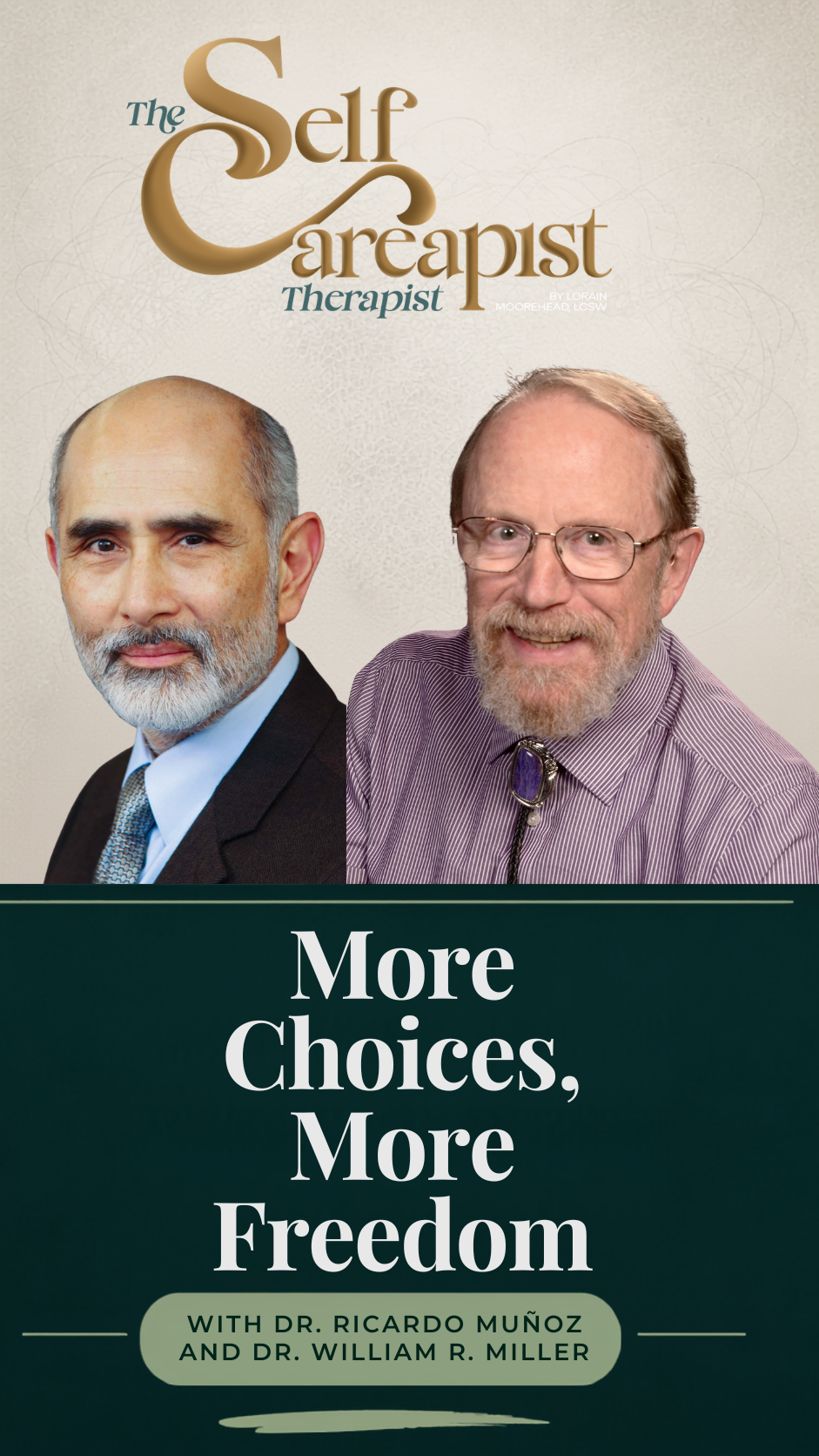
Fifty years of research from the co-authors of Rethinking Drinking, including the study that found one therapist’s clients had a 100% success rate and another’s had 25%, using the exact same treatment manual.
Guests: Dr. William R. Miller, Ph.D. & Dr. Ricardo F. Muñoz, Ph.D · Co-authors, Rethinking Drinking
For the therapist short on time
- The old “alcoholic vs. social drinker” binary never had research behind it. Drinking sits on a spectrum, and moderation is an achievable, evidence-supported goal for many clients, not just abstinence.
- A self-help book with no therapist involved cut problem drinking by the same margin as live counseling. Miller found this by accident in 1975, then replicated it three times.
- Across nine therapists using an identical treatment manual, the most empathic got 100% of clients to improve. The least empathic got 25%.
- Motivational Interviewing was built to replace an authoritarian model the field wrongly believed worked, based on a personality-disorder theory of addiction that never held up.
You have probably run into the old binary somewhere in your training: a client either has a drinking problem, in which case abstinence is the only real goal, or they do not, in which case there is nothing to discuss.
That is the research territory Dr. William R. Miller, Ph.D., and Dr. Ricardo F. Muñoz, Ph.D., have worked in for fifty years, since they shared a converted wartime barracks as an office as graduate students at the University of Oregon. Miller went on to originate Motivational Interviewing, now used worldwide across mental health, medicine, and dentistry. Muñoz spent thirty-five years at San Francisco General Hospital and built much of the research base for preventing depression before it starts, including a perinatal depression program now cited by the U.S. Preventive Services Task Force. This September, they published the fifth edition of the book they wrote together first as students, Rethinking Drinking.
Recently, I had the opportunity to interview both of them on the Self Careapist Therapist podcast, where we discussed what fifty years of data changed about treating problem drinking, the real origin story of Motivational Interviewing, and a study that should change how you think about your own caseload.
The Binary Your Training Probably Taught You
When Miller and Muñoz wrote the first edition of this book in 1976, the field’s consensus was that there were only two kinds of drinkers: alcoholics, who could never drink again, and everyone else, who had nothing to worry about. Miller’s dissertation, one of the first studies to test whether problem drinkers could learn to moderate rather than abstain, was considered controversial for exactly that reason.
Fifty years of data has closed that gap. The World Health Organization now states there is no truly safe level of alcohol consumption, drinking has declined steadily since 1980, and about half of American adults now drink rarely or not at all. “Either you were alcoholic and would be unable to cut down your drinking,” Miller said, describing the old model, “or you weren’t, then what’s the problem. We now know that the latter is not true.”
The Self-Help Finding That Surprised the Researchers
In 1975, Miller ran a study using his own self-help book as a control condition, the comparison group against which live counseling would presumably win. It was a surprise when it did not. People randomly assigned to work through the book alone, with no counselor, reduced their drinking by roughly the same margin (about 64%) as people who received live counseling using the same methods. Miller replicated the finding three times after moving to the University of New Mexico.
“People are able to use this material on their own to, on average, have about the same outcome as they would if they’re working with a counselor using the same methods.”Dr. William R. Miller, Ph.D.
The finding extends past a single session, too. In a later dissertation study, clients who were randomly given the book at the end of treatment kept reducing their drinking afterward. Clients who did not receive it stayed flat. For clinicians, that reframes bibliotherapy: not a lesser substitute for counseling, but a legitimate maintenance tool with its own evidence base.
A Low-Barrier Screening Model: The Drinker’s Checkup
Miller also ran free “drinker’s checkups,” advertised in the newspaper for anyone who wondered whether their drinking had become a problem, explicitly framed as assessment rather than treatment. Almost everyone who showed up wondering was, in fact, drinking at a level causing some harm.
One tool from that program is simple enough to hand a client directly: writing down the time and the drink before having it, every time, for a week, with no instruction to change anything yet. Drinking dropped by about a third in that first week from the self-monitoring alone. “I never really thought about how much I was drinking,” was the common response. The mechanism is awareness, not willpower, and it costs nothing to try with a client this week.
Healthy Management of Reality: The Framework Behind Part Four
Muñoz’s clinical framework, drawn in part from his undergraduate work with Albert Bandura, centers on self-efficacy: the idea that people can actively shape their day-to-day reality with cognitive and behavioral tools, rather than simply reacting to it. He reframes the treatment goal itself around freedom of choice rather than restriction.
“If somebody only knows how to deal with depression by using alcohol, they really don’t have any choice. But if they can learn other ways of doing it, then they have choices, they have freedom. That’s what we’re trying to encourage.”Dr. Ricardo F. Muñoz, Ph.D.
This matters clinically because a lot of problem drinking starts in adolescence as a coping tool for social anxiety or emotion regulation, learned early precisely because alcohol is so available. Treatment, in this framing, is less about removing a behavior and more about building out the alternatives a client never had.
The Real Origin Story of Motivational Interviewing
Before MI, Miller describes the addiction treatment field as genuinely moralistic and authoritarian, built on the mistaken belief that alcohol and drug problems came packaged with a specific, defensive personality disorder. “A therapist might literally say to a person coming in with alcohol problems, sit down and shut up. I’m going to tell you what’s wrong with you,” Miller said. “It turns out that was the result of the way in which we were treating people.”
Motivational Interviewing reversed the model entirely: instead of installing insight the client is assumed to lack, the therapist draws out motivations for change the client already has. Its core premise is that ambivalence about change is normal, and that confrontational counseling produces the exact defensive response it is trying to overcome. MI has since spread well past addiction treatment, into general medicine, dentistry, and work with clients managing chronic conditions like diabetes and schizophrenia.
The Study That Should Change How You Think About Your Own Caseload
This is the finding with the widest reach beyond alcohol treatment specifically. In Effective Psychotherapists, Miller and co-author Theresa Moyers reviewed seventy years of psychotherapy outcome research to answer a specific question: why do therapists using the identical treatment manual, in the same clinic, get such different results from their clients? They identified eight characteristics, not personality traits but learnable skills, and empathic listening topped the list by a wide margin.
“The most empathic therapist, 100% of her clients were successful in making changes. And the least empathic of the nine therapists had a 25% success rate using the same manual.”Dr. William R. Miller, Ph.D.
The raters could not even afford video at the time; three supervisors independently scored empathic listening through a one-way mirror using a Rogers-derived scale, and their rankings agreed closely. The other seven characteristics (affirmation, acceptance of the client as they are, clear shared goals, and delivering information or advice in a way that does not trigger defensiveness) round out the list. The throughline across all eight: the how of treatment carries real, measurable weight independent of the what.
Preventing Depression Before It Starts
Muñoz’s parallel research thread challenged a specific claim from a 1980s NIMH publication stating that the onset of major depressive episodes could not be prevented. He ran the first randomized controlled trial designed specifically to test that claim, and four decades of follow-up work since has built real evidence that new episodes can, in fact, be prevented. His Mothers and Babies Course, aimed at perinatal depression, is now credited by the U.S. Preventive Services Task Force with preventing 53% of new cases in the populations studied. The clinical manuals behind that work are free, available in multiple languages, and linked below.
Key takeaways for your next session
- Try the self-monitoring card. Having a client log the time and drink before each one, with no other instruction, has produced roughly a one-third reduction in a single week.
- Empathic listening is not a soft skill footnote. In head-to-head comparisons using an identical manual, it was the single largest predictor of whether clients actually improved.
- Bibliotherapy holds up as a real intervention, not a fallback. Consider Rethinking Drinking as a between-session or maintenance tool, not only a referral for clients who decline counseling.
Resources mentioned in this episode
- Rethinking Drinking, Miller & Muñoz (Guilford Press, 5th edition, September 2026)
- Effective Psychotherapists: How They Develop and Practice, Miller & Moyers
- Dr. William Miller’s full list of books and resources
- Free depression prevention and treatment manuals (English, Spanish, and several additional languages)
Listen to the Full Conversation
This post captures the research framework, but the full episode on the Self Careapist Therapist podcast goes considerably deeper. Bill, Ricardo, and I also discuss:
- Ricardo’s own decision, made in a Stanford dorm room in the 1970s, never to drink at all
- The mindfulness section of Rethinking Drinking, and how it differs from the book’s CBT-based chapters
- Why older adults and adolescents face different alcohol risk patterns, and what that means for screening
Listen on Apple Podcasts · Watch on YouTube · Listen on Spotify


+ show Comments
- Hide Comments
add a comment